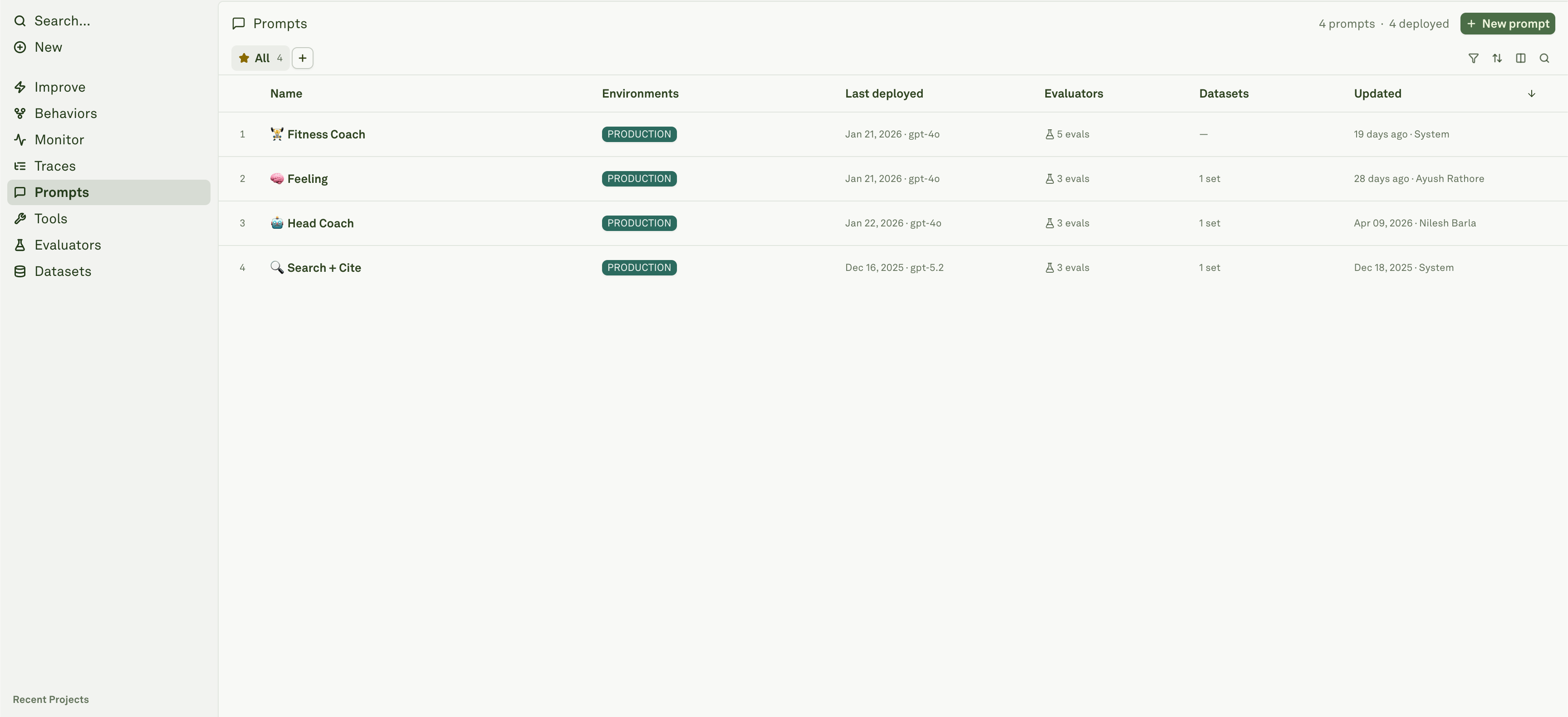
Prompts are the main levers your AI application uses at runtime. A prompt can include model settings, messages, variables, files, tools, response formats, evaluators, datasets, versions, and deployments. In the self-improving loop, prompts are the change surface. Logs and Behaviors explain how the current prompt behaves in production; Evaluators and Datasets define what must be preserved; Improve or human editing creates the next candidate; Deploy makes the reviewed version available to your application. Project libraries showing prompts, tools, evaluators, and datasets

What a prompt contains

AreaWhat you configure
Model settingsProvider, model, temperature, max tokens, response format, and other generation controls.
MessagesSystem, user, assistant, and tool messages with text, images, PDFs, and examples.
VariablesRuntime inputs such as {{user_question}}, {{context}}, or API/prompt-backed values.
ToolsProject tools and optional MCP server tools when enabled.
EvaluationLinked datasets and evaluators for testing across cases.
VersioningDrafts, snapshots, deployment history, and Improve candidates.

Build and test

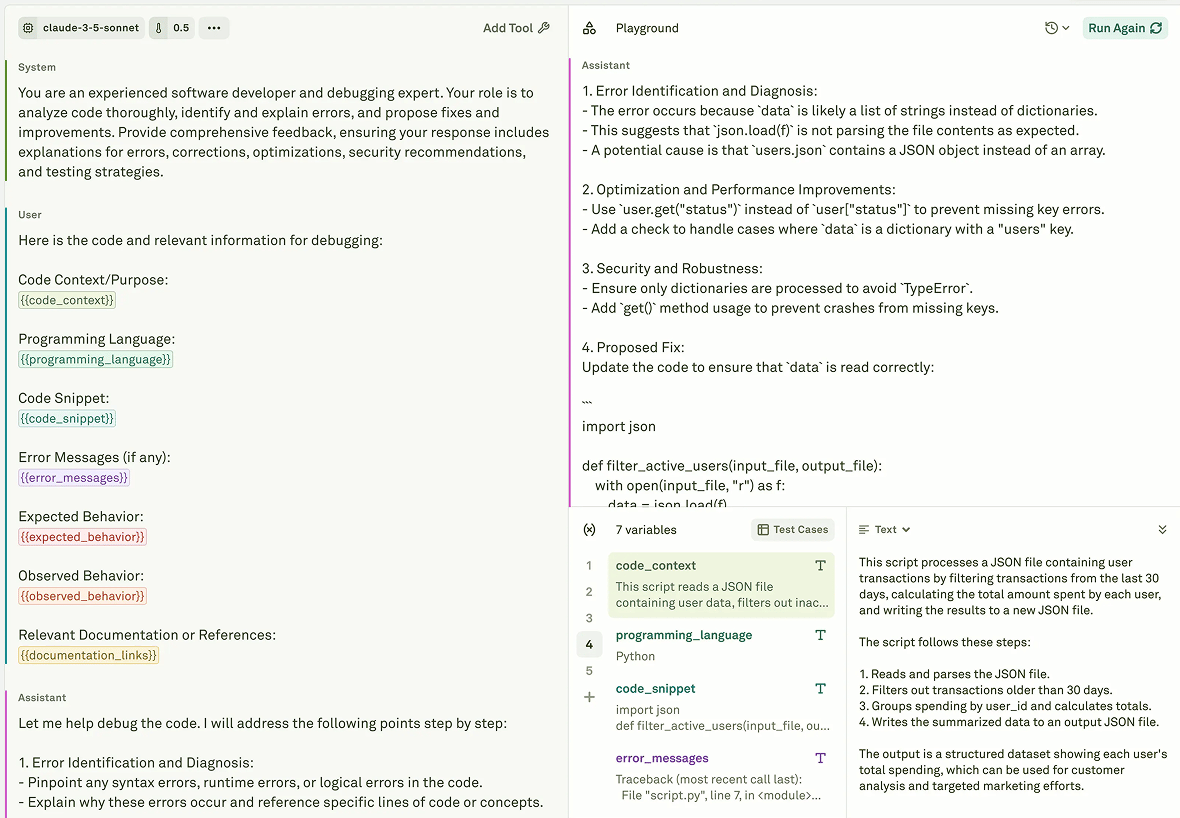
Prompt editor in Adaline showing model configuration, messages, variables, and playground workflow The authoring loop is:
  1. Choose a model and configure generation parameters.
  2. Compose messages with roles and content.
  3. Add variables for runtime inputs.
  4. Attach tools when the model needs external actions or data.
  5. Run the prompt in the playground with representative inputs.
  6. Link datasets and evaluators before deployment.
For the step-by-step workflow, see Build and test prompts.

Messages, variables, and tools

Older prompt docs called this the Iterate workflow. In the current Platform sidebar, the same authoring concepts live under Prompts.
ConceptUse it for
RolesStructure system, user, assistant, and tool context.
TextWrite instructions, examples, comments, and variable placeholders.
Images and PDFsAdd multimodal context for supported models.
VariablesMake prompts reusable across users, datasets, API inputs, and chained prompts.
API variablesFetch live data into prompt context.
Prompt variablesUse one prompt’s output as another prompt’s input.
Tools and MCPLet the model call external functions, APIs, retrieval systems, or MCP tools.
Keep variable names stable. Datasets, dynamic columns, API integrations, and chained prompts depend on them resolving consistently.

Playground
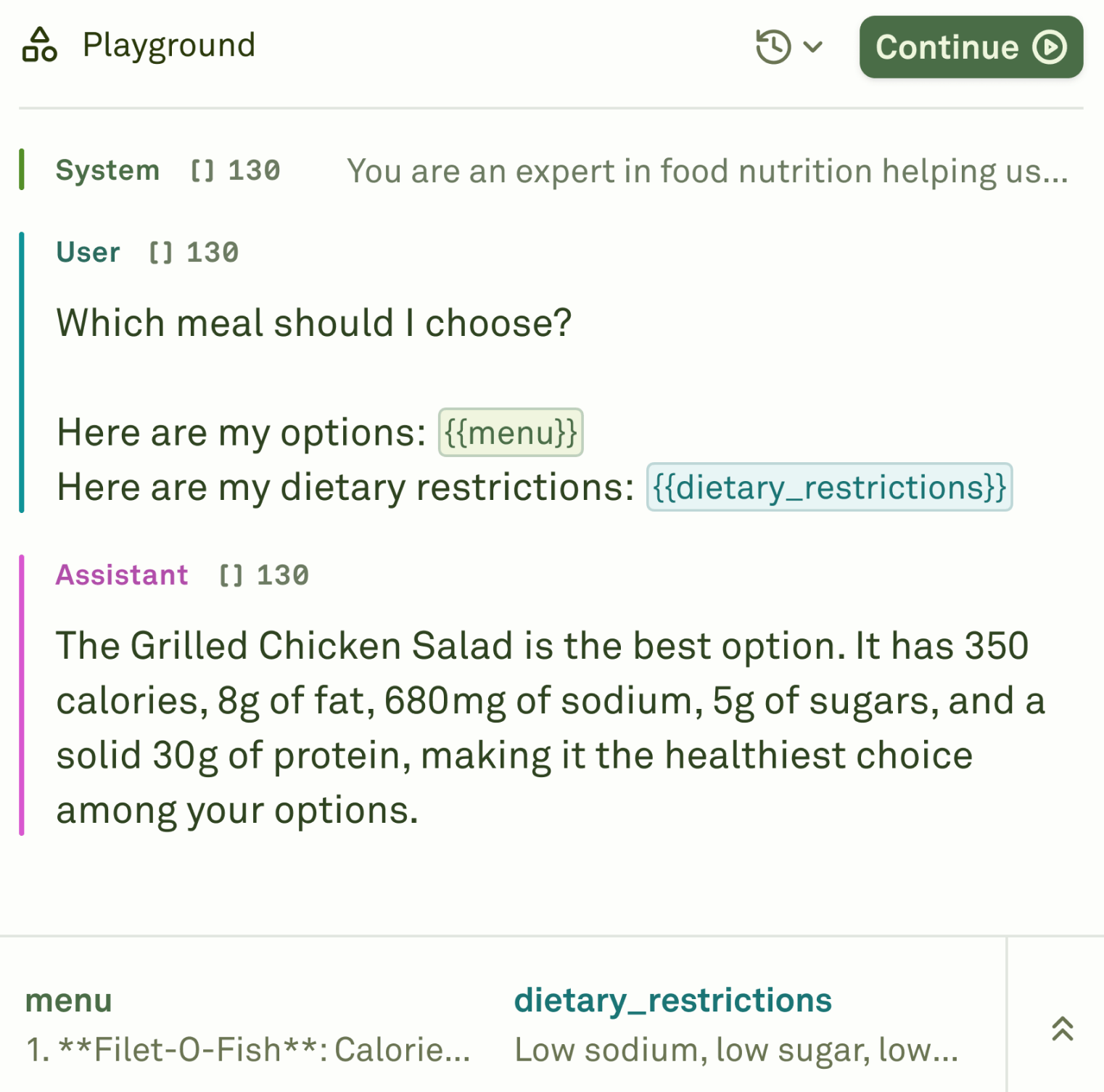
Adaline Playground for running prompts with inputs and comparing model responses Use the playground to execute prompts with specific inputs, inspect model responses, compare configurations, and debug tool calls before running larger evaluations. The playground is useful for fast iteration, but it is not a replacement for datasets and evaluators. Use it to understand behavior, then run evaluations to test many cases.

Versioning and deployment

Editing a prompt changes the draft. Deployment creates a snapshot for an environment. Your application should read from the deployment environment it expects, not from an arbitrary draft.
StateMeaning
Draft/editor stateWhere prompt editing and playground work happen.
Prompt version or snapshotCaptured state used for review or deployment.
Deployment snapshotWhat an application environment reads at runtime.
Improve approvalCan apply a candidate and deploy it, while Edit & approve applies it without deployment.
Use prompt versions and deployment snapshots as the release model for production changes.

Prompts in the Platform workflow

  • Tools define callable functions or HTTP-backed actions.
  • Evaluators define success criteria.
  • Datasets provide test cases.
  • Logs show deployed prompt behavior in production.
  • Behaviors cluster recurring outcomes.
  • Improve proposes prompt changes from those signals.
  • Deploy ships a prompt version to an environment.

Build and test prompts

Configure messages, variables, model settings, tools, datasets, and playground runs.

Version and deploy

Understand drafts, snapshots, deployment environments, approval, and rollback.

Tools

Define reusable tool schemas and HTTP-backed actions.

Evaluators

Define pass/fail, scoring, cost, latency, and formatting criteria.